


Saquon Barkley
Summary
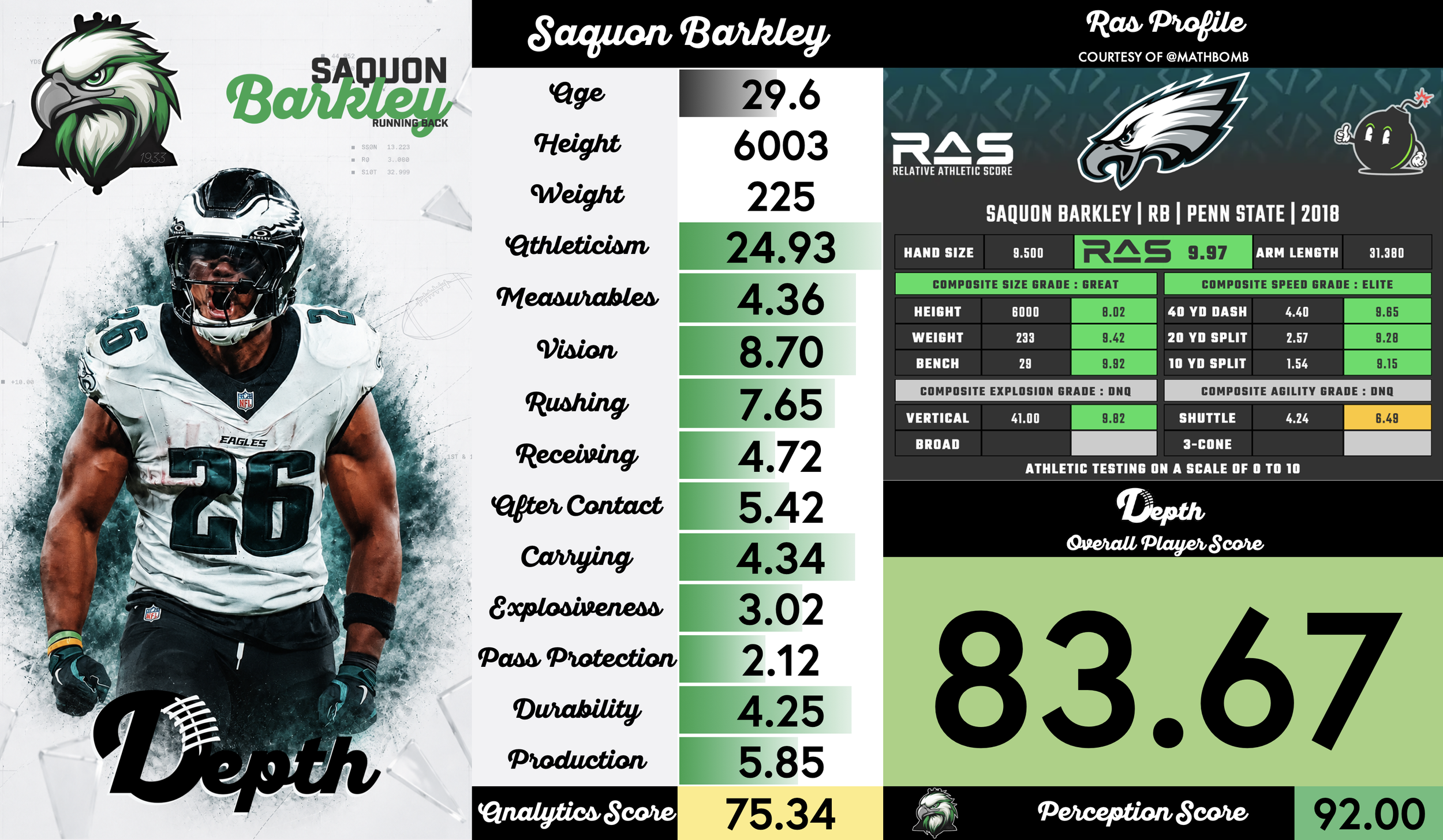
Saquon Barkley was drafted in theRound 1 (#2 Overall) of the 2018 NFL Draft out of Penn State University. Barkley was one of the most electrifying players in college football with the Nittany Lions, where over three seasons (2015–2017) he rushed for 3,843 yards and 43 rushing touchdowns, and added 1,195 receiving yards with 8 receiving touchdowns. He left college as Penn State’s all-time leader in all-purpose yards (5,538), total touchdowns (53), and rushing touchdowns (43). In the NFL, Barkley has shown elite-level production. In 2024 (his first season with the Philadelphia Eagles), he rushed for 2,005 yards with 13 touchdowns and also contributed as a receiver — his best season yet — helping lead the Eagles to a championship, and earned league honors including AP NFL Offensive Player of the Year. Over his career (through 2025), he has logged approximately 7,000+ rushing yards and 48 rushing touchdowns, with 321 receptions for 2,378 receiving yards and 14 receiving touchdowns. Off the field and in terms of character and versatility, Barkley has long been hailed for his combination of power, agility, speed, receiving ability, and versatility as a runner/receiver/returner — traits that made him one of the most dynamic backs entering the League.
Strengths
Breakaway Dynamo: Barkley often turns modest gains into long ones, stretching defenses vertically or breaking free for explosive plays, both rushing and receiving. His thick lower body and ability to squat a small European car make him a formidable foe to tackle.
Pass Catching & Three Down Value: From Penn State to the pros, Barkley has shown he can produce on the ground, catch out of the backfield, and contribute in all-purpose roles — a true dual-threat back. He’s not quite Christian McCaffrey as a receiver, but he’s not far off either, although admittedly his 2025 receiving production dwindled.
Human Highlight Reel: His agility, balance through contact, and ability to navigate creases or cut back make him effective between the tackles as well as on outside runs. His backwards hurdle over Jarrian Jones that graced the cover of Madden will live in NFL Films immortality.
Clutch: Even when Barkley is not having a huge day, he has a tendency to come up biggest when the game is on the line in the fourth quarter. Doesn’t become mentally subdued after slow starts and mentally resilient.
Weaknesses
Durability/Long Term Injuries: Barkley’s career has been sporadically hindered by injuries, which has sometimes limited his availability or production. Barkley is such a tightly wound and strong athletes that sometimes muscles and tendons can pop.
Not a Grinder: While capable of explosive runs, there are games where he fails to consistently churn out positive yardage or late-down tough yards inside the box. As with many dynamic backs, Barkley’s effectiveness often correlates strongly with the quality of run blocking, scheme design, and offensive context.
Pass Protection/A-Gap Running: Given his size and style (explosive, agile, speed-based), he's less likely to excel as a pure power back or lead-blocking back compared to more traditional, bigger runners. Barkley is also adequate but not elite in pass protection.
Workload/Wear-and-Tear: Joe Schoen and the New York Giants famously low-balled Barkley, citing concern over the amalgamation of severe injuries in his early career (thanks MetLife turf), and while they were woefully wrong at the time, father time is known to have extra limited patience for running backs.
Outlook
Barkley fits best as a lead back and three-down running back in an offense built to maximize his versatility — in both rushing and receiving — ideally with strong offensive line play, a balanced/run-heavy or balanced offense, and creative use of his pass-catching skills. With his combination of speed, power, receiving, and playmaking ability, he remains a rare “complete back” capable of producing big plays on the ground, contributing in the passing game, and handling a high volume of touches. Looking ahead, Barkley’s outlook remains very positive, particularly if he stays healthy and the offensive environment supports his strengths. Given what he accomplished in 2024 (2,005 rushing yards, 13 TDs, plus receiving yards, and helping lead a championship run), it’s clear that when healthy and used properly he still ranks among the elite running backs in the NFL. His skill set and track record suggest he can continue as a high-end RB1 for the next few seasons, providing both reliability and explosiveness. However, durability and ability to survive current offensive coordinator Kevin Patullo’s scheme will be key to maximizing his remaining prime years. As he accumulates more touches and seasons, the risk of wear-and-tear increases; maintaining explosiveness and health will determine whether he remains a top-tier back or transitions into a more limited, complementary role.


Report written by Filip Prus